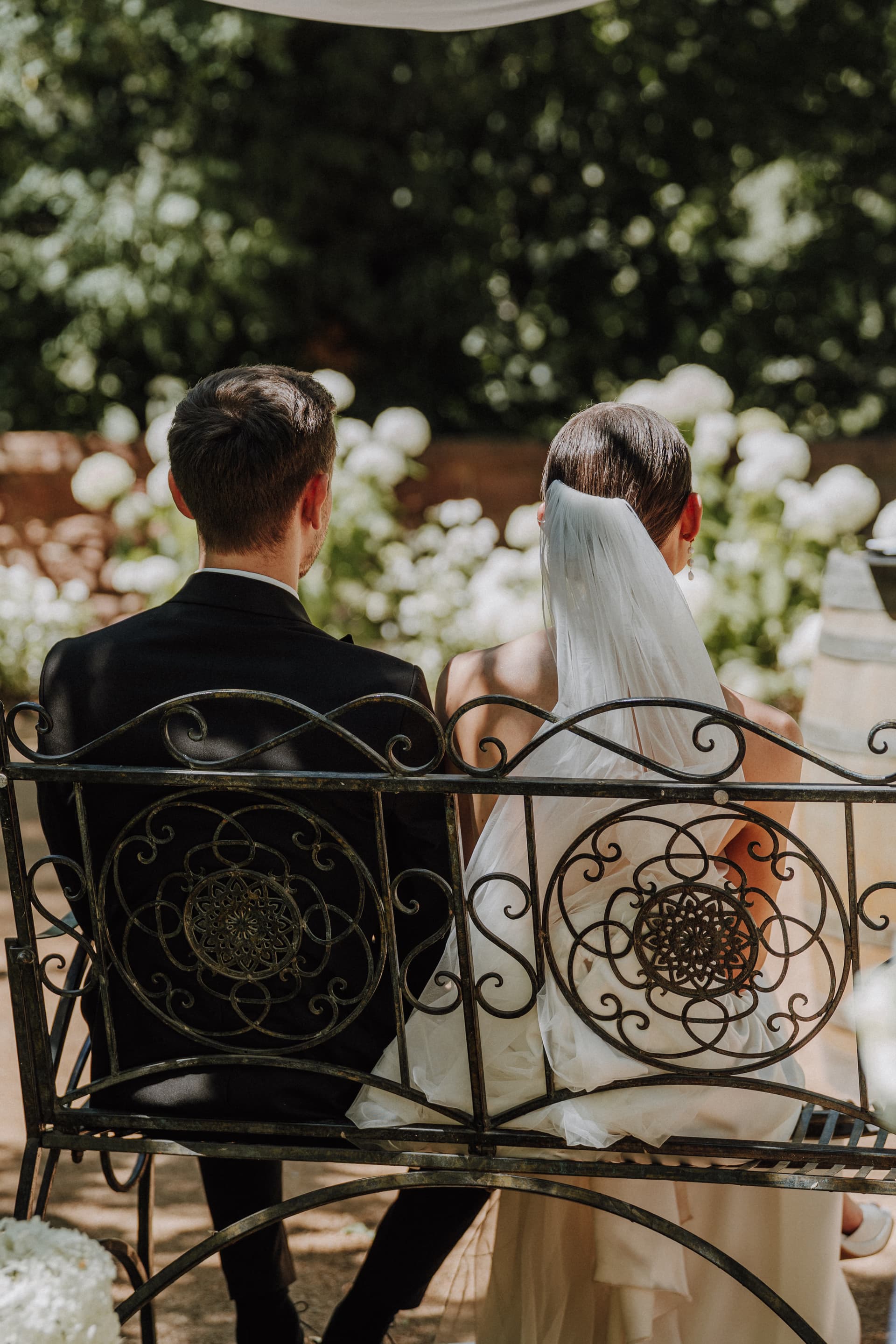
What a symbolic ceremony actually is.
In Germany, only a registry office (Standesamt) can perform a legally binding marriage. Everything else — a ceremony in a garden, a church blessing, a celebrant under a tree — is symbolic. It carries no legal weight but carries all the emotional weight.
Most couples who choose a symbolic ceremony do the legal paperwork at the registry office on a weekday with two witnesses, then hold the "real" wedding at the venue with everyone present. The legal ceremony is usually quiet, 15 minutes, bureaucratic. The symbolic ceremony is the wedding.
This split is increasingly common in Germany — not because couples care less about the commitment, but because it gives them complete freedom over the ceremony itself.
What the ceremony involves.
A symbolic ceremony is led by a celebrant — someone who has been trained to create and conduct personalised ceremonies. The celebrant typically meets with the couple 2 to 3 times before the wedding to write the ceremony together.
The ceremony might include personal vows, readings from family or friends, rituals (candle lighting, hand-fasting, sand ceremony), music, and whatever else the couple wants. There is no fixed format and no legally required language.
Length is typically 30 to 60 minutes. Most ceremonies end with the exchange of rings and a declared commitment — the moment that matters, regardless of what the registry office says.
What it costs.
A celebrant for a symbolic ceremony in Germany typically charges between €700 and €1,800. The range reflects experience, the time involved in writing the ceremony, and travel.
The registry office ceremony (Standesamt) costs €80 to €200 depending on the municipality and whether you hold it during regular office hours or request a special appointment.
Celebrant, registry office fee, and travel together come to roughly €800 to €2,100. Add decoration, music, and sound for the ceremony itself, and most couples land between €1,500 and €3,500. This is still one of the lower-cost elements of a wedding budget.
How to find a celebrant.
Ask your venue for recommendations first. A celebrant who knows the space — where to stand, how the acoustics work, where the light is at 4 p.m. — runs a better ceremony than one who walks in on the day.
Look for someone whose previous ceremony texts you can read. Many celebrants share examples online. The writing style matters as much as the person.
Book early. Good celebrants take only 15 to 20 weddings per year. In peak season in the Palatinate, they fill up 9 to 12 months in advance.
At Villa Renting
The walled garden at Villa Renting (Eisenberg) is set up for symbolic ceremonies — shaded, enclosed, space for up to 100 seated guests. We work with a list of experienced celebrants who know the space. The registry office in Eisenberg is five minutes away for the legal paperwork.
Check my date